
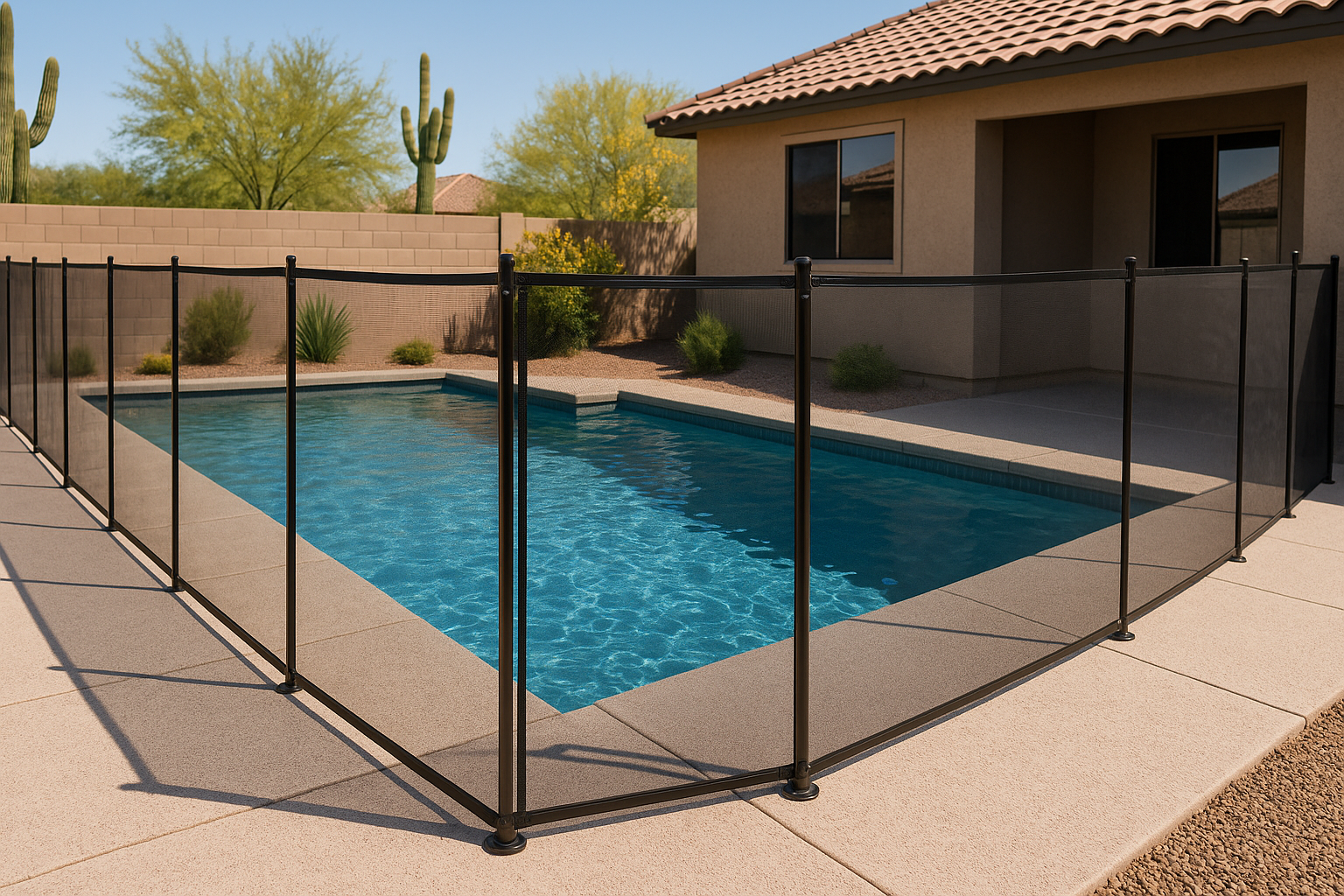
Living in Mesa, Arizona, having a backyard swimming pool isn’t just a nice luxury; honestly, it’s practically a survival requirement when the summer heat cranks up. But keeping your kids and pets secure around the water means your pool safety fencing needs to stay in solid working condition year after year. Let me explain how you can easily care for that barrier so it lasts as long as your family’s best swimming memories.
Contents
- 1 The Desert Sun, Monsoon Dust, and Your Fence
- 2 Routine Cleaning: Less Scrubbing, More Lifespan
- 3 The Secret Sauce of Mesh Fencing: Proper Tension
- 4 Inspecting Poles, Pegs, and Deck Sleeves
- 5 The Gate: The Unsung Hero of Pool Safety
- 6 A Quick Monthly Walk-Through
- 7 DIY vs. Calling in the Cavalry
- 8 Keep Your Backyard Safe and Beautiful
The Desert Sun, Monsoon Dust, and Your Fence
Here’s the thing about living in the Valley of the Sun. Our weather is absolutely brutal on outdoor equipment. Between the blazing July heat baking your backyard and those late-summer monsoon storms blowing half the desert onto your patio, your Mesh Pool Fence takes a serious beating.
You might think a mesh barrier is entirely maintenance-free. Well, yes and no. It’s highly durable, sure, but ignoring it completely is a surefire way to cut its lifespan short. Dust settles into the tiny holes of the mesh. UV rays constantly beat down on the fabric. If you don’t give it a little attention, you will eventually notice the material starting to look dull and tired. And nobody wants an eyesore right in the middle of their beautiful outdoor oasis.
The good news? Keeping it looking fresh and functioning perfectly doesn’t require a master’s degree in engineering. Just a few simple habits will keep things tight, clean, and incredibly safe.
Routine Cleaning: Less Scrubbing, More Lifespan
You know what? Most homeowners overthink the cleaning process. You really don’t need harsh chemicals, bleach, or expensive specialty cleaners. Using abrasive chemicals will actually break down the UV coating on the mesh fabric, which eventually makes the material brittle and dangerous.
Instead, grab a bucket, some warm water, and regular mild dish soap like Dawn. A soft-bristled brush—maybe something you’d use to wash your car—is perfect for the job. Just gently scrub the mesh panels to loosen the desert dirt, and hose it down with regular water pressure. Avoid using a pressure washer. A high-powered blast of water can stretch the fabric or even fray the edges, which totally ruins the tension.
Arizona is notorious for hard water. Because of that, you might start noticing white, chalky calcium spots forming near the bottom of your fence where the pool water splashes. If that happens, mix equal parts white vinegar and water in a spray bottle. Let it sit on the hard water spots for a few minutes, gently scrub, and rinse. It works like magic.
| Maintenance Task | Recommended Frequency | What You Will Need |
|---|---|---|
| Basic Mesh Washing | Every 2-3 months | Mild dish soap, soft brush, hose |
| Hard Water Removal | Twice a year | White vinegar, water, spray bottle |
| Ground Sleeve Flush | After heavy storms | Garden hose with spray nozzle |
The Secret Sauce of Mesh Fencing: Proper Tension
If there is one single thing you need to remember about maintaining your pool fence, it is this: tension is everything.
Think of your fence like a giant guitar string. For a guitar to play the right notes, the strings have to be pulled tight. For your mesh barrier to keep a wandering toddler out of the water, the panels must be taut. If the mesh feels loose or sags in the middle, it suddenly becomes something a clever kid can pull down or climb over.
Every couple of months, walk the perimeter of your pool. Give the top border of the mesh a gentle push. It should snap right back. If it feels floppy, you might have an issue with the poles leaning inward, or the mesh itself might need a slight adjustment. Sometimes, simply pulling the poles out of their sleeves and resetting them firmly can fix a minor tension issue. If you have sections that are consistently sagging, though, you might need a professional to shorten the mesh and re-attach it to the pole.
Inspecting Poles, Pegs, and Deck Sleeves
Your fence panels are supported by aluminum poles that drop into plastic or brass sleeves drilled directly into your concrete pool deck. Aluminum is fantastic because it will never rust. But wait, there is a catch.
While the poles won’t rust, the ground sleeves they sit in are basically tiny little cups waiting to collect dirt, sand, and monsoon debris. When dust fills up those holes, the poles can get stuck. If you ever need to remove your fence for a backyard party, trying to yank a jammed pole out of a gritty sleeve is a frustrating, sweaty nightmare.
Here is a simple trick. When you take the fence down, immediately flush the deck sleeves with your garden hose to blast the dirt out. Let them dry completely before putting the poles back in. If a pole still feels a bit sticky going in or coming out, grab a can of dry Teflon or graphite spray lubricant. Spray a tiny amount on the peg at the bottom of the pole. Do not use standard wet lubricants like WD-40 for this specific task. Wet lube just attracts dirt, leaving you with a gummy, stuck mess.
The Gate: The Unsung Hero of Pool Safety
Your gate is the unsung hero of your backyard safety system. It is the only part of the fence that actually moves every single day. Because it gets so much traffic, the self-closing hinges and the self-latching mechanism need your attention more than anything else.
Most high-quality setups use a magnetic latch system, like a MagnaLatch. These are incredibly reliable, but they only work if the gate actually closes all the way. Go ahead and open your gate just an inch or two, then let it go. Does it swing shut and click securely? If it hesitates or stops short, you need to adjust the tension on the hinges.
Usually, this just takes a flathead screwdriver and about two minutes of your time. You adjust the internal spring until the gate swings closed firmly from any angle. Also, check how the latch lines up. Ground shifting is super common in Mesa due to our dry soil expanding and contracting. If the ground shifts, the gate poles might lean slightly, causing the latch to miss its mark on the locking mechanism. If the magnet isn’t catching perfectly, you can easily adjust the latch height up or down by loosening the screws on the side.
A Quick Monthly Walk-Through
Before we move on, let’s simplify your routine. If you just take five minutes once a month to look things over, you catch small problems before they turn into expensive headaches.
- Check the mesh panels for any small holes, tears, or excessive fading from the intense Arizona sun.
- Test the gate hinges by opening the door just an inch and letting it go to ensure it clicks firmly shut.
- Wiggle the poles gently to make sure they are sitting firmly in the deck sleeves without leaning inward.
- Clear away debris from the bottom of the fence so water and wet dirt don’t build up along the border.
DIY vs. Calling in the Cavalry
Now, I know I just spent all this time telling you how easy it is to handle swimming pool fence maintenance yourself. But honestly? Sometimes you just shouldn’t touch it.
It sounds contradictory, I know. Mild cleaning and tension checks are great DIY projects. But let’s say a massive summer microburst blows through and actually bends one of your aluminum poles. Do not try to bend it back into shape yourself. Aluminum weakens significantly once it creases. Bending it back might make it look okay, but it ruins the structural integrity. If a child leans against a compromised pole, it could snap entirely.
Let’s talk about pets for a second, too. We love our dogs, but a bored Golden Retriever can do a surprising amount of damage to a mesh panel if they decide to dig or scratch at it. A tiny little snag from a dog’s paw might not seem like a big deal right away. However, the tension of the fence will eventually pull that small snag into a massive tear. You can’t just patch it with heavy-duty tape and call it a day. That compromised section needs to be properly replaced by someone who understands exactly how to restore the correct tension across the entire barrier.
Knowing your limits is a huge part of being a responsible homeowner. You change your car’s wiper blades, but you probably let a mechanic handle the transmission, right? Your child safety pool fence works the exact same way. Handle the routine care, but leave the heavy repairs to the folks who do this every single day.
Keep Your Backyard Safe and Beautiful
Maintaining your pool barrier isn’t a massive chore, but it definitely requires a little bit of consistency to keep your loved ones secure. If you notice torn mesh, bent poles, or just need an expert eye to ensure your barrier is fully intact, we are here to help. Reach out to the team at Pool Safety Fencing by phone # 480-771-8026 to discuss your repair needs, or Request A Free Quote to upgrade your current backyard setup.