
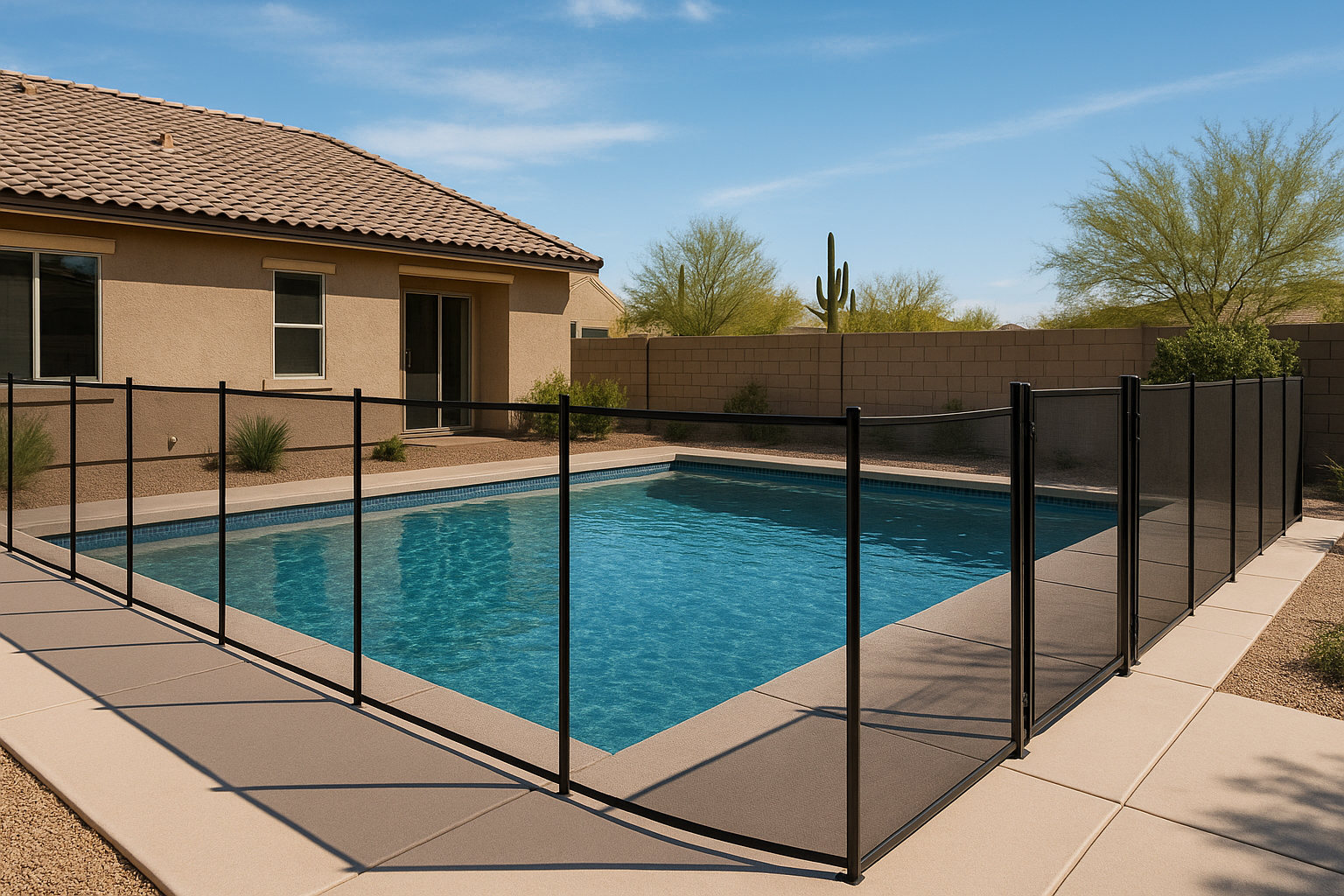
Living in Mesa means dealing with summers that feel like a literal oven, making a backyard pool less of a luxury and more of a strict survival tool. But when you have little kids running around, that sparkling oasis quickly turns into a massive source of anxiety. Figuring out how to keep your family safe while navigating the maze of local city codes can give you a major headache.
Contents
The Reality of Backyard Pools in the Desert
You know what? There is absolutely nothing better than stepping out onto your patio in mid-July and seeing that cool, blue water waiting for you. Honestly, it makes the brutal Arizona heat almost bearable. We spend so much time cleaning the filters, skimming out the palo verde leaves after a monsoon dust storm, and balancing the chemicals. It becomes a massive part of our daily routine.
But here is the thing. Owning a pool comes with a heavy burden of responsibility. The statistics around water accidents are tough to stomach, especially here in Maricopa County where swimming season lasts most of the year. That is exactly why local governments step in with strict rules. They aren’t trying to punish you; they are trying to prevent tragedies.
At first glance, you might think you do not need an interior barrier if your yard is completely enclosed by a standard, six-foot block wall. Well, yes and no. It depends heavily on who lives in the house, who visits the property, and exactly when the pool was originally built. Making sense of the overlapping rules between the state of Arizona, the city of Mesa, and your local neighborhood association can feel like trying to read a foreign language backward.
Making Sense of the Legal Mumbo Jumbo
Let me explain how the law actually looks at your backyard. The state sets a firm baseline, and then local municipalities like Mesa add their own specific flavors to the mix.
If you have a child under the age of six living in your home, Arizona law mandates a dedicated barrier directly around the water. Even if you do not have kids of your own, maybe you foster children, run an in-home daycare, or frequently have young nieces and nephews over for weekend barbecues. In those scenarios, you still fall under heavy legal scrutiny.
The technical term the city uses is a “pool enclosure.” But what does that actually look like for an average homeowner staring out at their patio? Let’s break down the core numbers.
| Requirement | City Code Spec | What It Actually Means |
|---|---|---|
| Minimum Height | 60 inches (5 feet) | The fence must be tall enough that a toddler cannot scramble over it. |
| Ground Clearance | 2 inches (soil) or 4 inches (hardscape) | Kids shouldn’t be able to squeeze underneath the bottom edge. |
| Gate Hardware | Self-closing and self-latching | The gate must shut and lock entirely on its own behind you. |
Now, you might be wondering why a five-foot height is standard when some older homes you visit only have a four-foot wrought iron fence. Older installations are sometimes grandfathered in, which seems like a mild contradiction to the safety-first mindset. However, if you are updating your yard, selling your house, or fostering a newly placed child, you will almost certainly need to meet the current, stricter standard.
Wait, Are Removable Fences Actually Allowed?
This is where people get confused. I hear this argument all the time. A homeowner will say, “I really want a mesh fence, but my neighbor told me they aren’t legal because you can easily take them down.”
They are literally called removable pool fences, so obviously, they can be removed. Doesn’t that completely defeat the purpose of a permanent safety barrier?
Actually, no. A high-quality Mesh Pool Fence absolutely passes local code inspections, provided it is installed properly by an expert. The secret ingredient here is tension. When a professional drills the sleeves into your concrete cool decking and inserts the fence poles, the mesh is pulled incredibly tight. It acts like a giant trampoline turned sideways. A kid cannot push through it, and because the mesh is woven so tightly, there are zero footholds for them to climb over it.
So, yes, it is legally considered a fully compliant pool fencing barrier while it is up. The beauty of this system is that if you host an adults-only evening in the middle of winter, you can roll the whole thing up and stash it in your garage. You just have to make sure it is securely locked back in place whenever children are present.
Key Elements of a Compliant Removable Fence
If you want your setup to easily pass a rigorous safety inspection in Mesa, you need to pay attention to the finer details. The city inspector will not just glance at it from the porch and walk away. They will physically push on it, measure the gaps, and test the gates multiple times.
- The latch placement matters. Usually, the release mechanism for a pool gate needs to be at least 54 inches from the ground. This keeps it completely out of reach for curious, stretching little hands.
- Gates must open outward. This is a brilliant bit of simple engineering. If a child leans their body weight against the gate, they are actually pushing it shut rather than forcing it open toward the water.
- Mesh must meet safety standards. You cannot just buy cheap netting from a discount site and string it up yourself. The material has to meet specific ASTM (American Society for Testing and Materials) guidelines for tear resistance and UV stability. Remember, the relentless Arizona sun eats cheap plastics for breakfast.
The Magic of the Self-Closing Gate
Let’s talk about gates for a second, because this is crucial. The gate is arguably the most important component of the entire system. It is also the number one reason well-meaning homeowners fail their city inspections. Why? Because people try to cut corners with manual latches.
A manual gate that you have to physically pull shut and lock with a padlock is a recipe for disaster. Humans are naturally forgetful. Imagine you carry a heavy tray of drinks out to the patio, bump the gate with your hip, and assume it clicked shut. But it didn’t. That tiny, two-inch gap is all a determined toddler needs to slip through.
That is exactly why Mesa city code demands self-closing, self-latching gates. This system relies on heavy-duty, tension-adjustable hinges. The very second you let go of that gate, it should swing shut with a satisfying, authoritative sound. The latch mechanism, typically a magnetic lock, pulls the locking pin into place automatically. If your gate doesn’t slam shut and lock from any open position—even if it’s only propped open an inch—it will not pass code.
The Elephant in the Neighborhood: Your HOA
Just when you think you have all the city regulations completely figured out, your Homeowners Association decides to join the chat. HOAs in the East Valley are notorious for having strict aesthetic guidelines that go above and beyond basic city safety codes.
They might heavily dictate the color of your fencing. Some neighborhoods only allow muted earth tones like brown or beige to match the desert landscape, while others are perfectly fine with standard black mesh (which, ironically, is actually the most transparent and easiest color to see through).
Always submit your plans to your architectural review committee before you drill a single hole in your deck. It is incredibly frustrating to install a beautiful, safe barrier only to get a nasty violation letter in the mail a week later because you picked the wrong shade of gray. Most professional installers can provide you with the exact spec sheets, heights, and color samples you need to keep the HOA board perfectly happy.
Why Not Just Build a Permanent Block Wall?
You might be asking yourself why you should bother with a removable option at all. Why not just put up a heavy wrought iron fence or a solid block wall right down the middle of the yard to meet pool safety regulations in Mesa once and for all?
Well, permanent structures chop your backyard in half forever. They are expensive, require messy heavy construction, and completely ruin the open visual flow of your landscaping. Think of it like buying a massive passenger van when you only need extra seats a few times a year. It gets the job done, but you are stuck driving a bus every single day, long after the kids have grown up.
A removable barrier gives you the absolute best of both worlds. It delivers total peace of mind when the kids are young and wild. Then, ten years down the road when everyone is a strong swimmer, you simply take it down. No jackhammers, no masonry crews, no permanently ruined patio.
Wrapping Your Head Around Compliance
Navigating local laws does not have to be an endless nightmare. Yes, the codes are incredibly strict, and yes, there is a lot of legal jargon to sift through. But the core goal behind all of these rules is delightfully simple: keeping kids safe from harm.
You don’t have to figure it all out on your own. Relying on an expert who deeply understands the local Mesa requirements, knows the exact drill angles needed for proper mesh tension, and installs premium materials makes the entire process incredibly painless. Your backyard should be a relaxing retreat where you can host barbecues and make memories—not a place that leaves you sweating bullets every time your toddler runs out the back door.
If you are feeling overwhelmed by the regulations or just want to make sure your backyard is fully protected, Pool Safety Fencing is here to help you sort it out. Give us a call by phone # 480-771-8026 to discuss your options with an expert, or Request A Free Quote directly on our website today. We will make sure your new barrier is safe, beautiful, and completely compliant.