
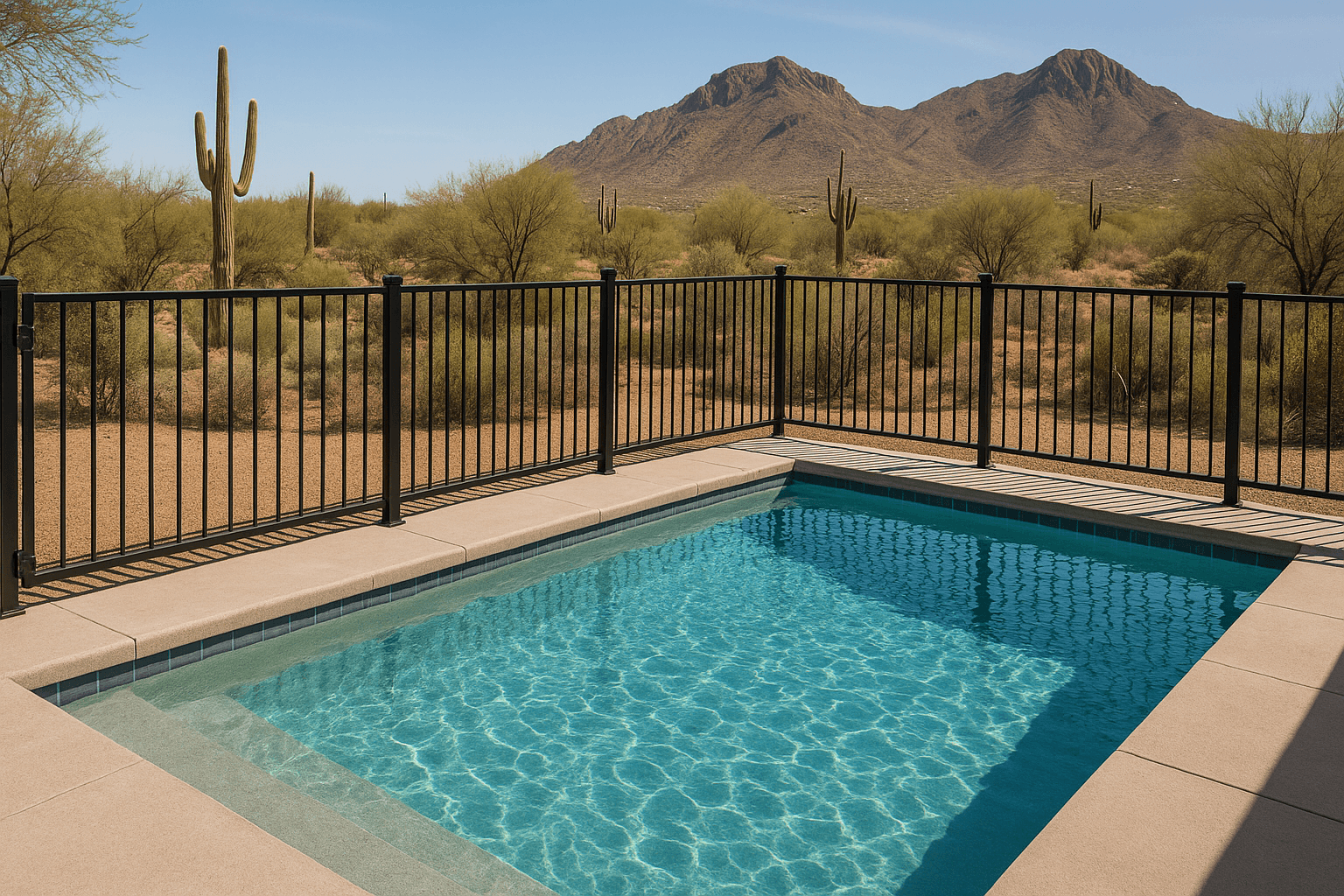
Living in Mesa creates a unique relationship with the summer; you spend half your time hiding from the sun and the other half trying to cool off in the water. But owning that backyard oasis comes with a serious set of responsibilities, particularly when we start talking about the safety barriers standing between your home and the deep end. It’s not just about peace of mind—it’s about navigating a specific set of city and state regulations that can sometimes feel a bit like deciphering a cryptic map.
Contents
Why Are the Rules So Strict Anyway?
You might be thinking, “It’s my yard, why does the city care what kind of fence I put up?” honestly, that’s a fair question. But the reality is that Arizona has some of the strictest pool barrier laws in the country, and for good reason. We aren’t just talking about bureaucracy here. The regulations are written in response to tragedy, specifically to prevent accidental drownings, which happen far too often in the Valley.
When you install a pool safety fence, you aren’t just ticking a box for the inspector; you are creating a literal lifeline. The regulations in Mesa are designed to remove human error from the equation. They assume that a door might be left ajar or that a child will be curious. So, when we talk about code compliance, we are really talking about layers of protection that work even when you’re distracted.
The “Must-Haves” for Your Fence
Let’s get down to brass tacks. Or, I suppose, aluminum rails. If you are looking at installing a new barrier or upgrading an old one, there are non-negotiable standards you need to meet. Mesa follows specific amendments to the International Building Code, and they don’t leave much wiggle room.
First off, let’s talk about height. A standard garden fence might not cut it. Generally, a pool enclosure needs to be at least 60 inches (5 feet) high measured from the finished ground level. Why 60 inches? It’s just tall enough to deter the average toddler or young child from pulling themselves over the top.
Then there is the issue of gaps. You know how kids can squeeze into spaces you didn’t think were possible? The code writers know that too.
The 4-Inch Sphere Rule
Here is a simple way to visualize it: if you can shove a soda can through the bars, your fence probably isn’t up to code. The gap between your vertical pickets generally cannot exceed 4 inches. If a child can fit their head through, they can get their whole body through.
Here is a quick breakdown of the critical measurements you need to keep in your head:
| Feature | Requirement | The “Why” |
|---|---|---|
| Fence Height | Minimum 60 inches (5 ft) | Prevents climbing and reaching over. |
| Ground Clearance | Maximum 2 inches | Stops kids or small pets from crawling under. |
| Gate Direction | Must open outward | If a child pushes on it, it closes tighter rather than opening up. |
| Latch Height | At least 54 inches high | Keeps the release mechanism out of a child’s reach. |
The Gate: The Weakest Link
You can have a fortress of a fence, but if the gate fails, the whole system is compromised. This is where I see the most confusion among homeowners.
A pool safety gate must be self-closing and self-latching. That means if you walk through it with a tray of burgers and forget to turn around and shut it, the gate needs to do the work for you. It should swing shut and click into a locked position strictly using gravity or spring tension.
You know what? Check your current gate right now. Open it about six inches and let go. Does it latch? Now open it all the way and let go. Does it still latch? If it bounces off the post or stops halfway, it’s not just annoying—it’s a code violation.
Why Aluminum is the Mesa Favorite
Now, you have choices when it comes to materials. You could go with wood, but let’s be real—the Arizona sun treats wood about as well as a magnifying glass treats an ant. Termites, rot, and warping are inevitable. You could go with wrought iron, which is traditional and heavy, but it requires constant painting to keep the rust at bay, especially if it gets splashed with chlorinated or saltwater.
This is where aluminum pool fencing really shines.
Let me explain why it’s become the standard for safety fencing in our area. Aluminum is naturally rust-resistant. You can have a saltwater pool, splash that fence every single day, and it won’t corrode the way steel does. Plus, modern aluminum fences are usually powder-coated. This isn’t just paint; it’s a baked-on finish that resists chipping, peeling, and fading under that harsh UV exposure we get here in Mesa.
The “Climbability” Factor
There is another subtle reason aluminum is great for regulations. The code strictly prohibits “footholds” or “handholds.” Basically, the fence can’t look like a ladder.
If you have a chain-link fence, the mesh is basically a staircase for a determined four-year-old. Wooden fences often have horizontal rails (stringers) that kids can stand on. Aluminum safety fences are designed with smooth vertical rails and horizontal rails that are spaced far apart (usually at the very top and very bottom), making it incredibly difficult for a child to get a leg up.
Here is something people often forget: your backyard probably isn’t perfectly flat. Even in Mesa, where things look flat, there is usually a grade for drainage.
Installing rigid panels on sloped ground can be a nightmare if you don’t know what you’re doing. This is called “racking.” A high-quality aluminum fence system is designed to rack, meaning the panel can pivot to follow the slope of the ground while keeping the pickets vertical.
If you don’t rack the fence, you end up with “stair-stepping.” While stair-stepping works, it often leaves large triangular gaps at the bottom of the fence where the panel steps up. Remember that 2-inch ground clearance rule? A stepped fence on a steep slope can easily create a gap larger than 4 inches at the bottom, and suddenly, you are out of compliance.
Don’t Forget the House
We often think of the pool fence as a border around the water, but the code actually views the “barrier” as anything that prevents access. Sometimes, the wall of your house serves as part of that barrier.
If you have a back door or a sliding glass door that opens directly into the pool area, you have a few options, but they are strict.
- Door Alarms: You might need an alarm that sounds immediately when the door is opened. And it has to be loud—specifically, 85 decibels loud.
- Self-Closing Doors: Just like the gate, the door from the house might need to be self-closing and self-latching.
Honestly, relying on alarms can be tricky. Batteries die, or teenagers disable them because they’re annoying. That is why many Mesa homeowners prefer to install a dedicated isolation fence—a fence that goes all the way around the pool, separating it from the house entirely. It’s the safest bet and usually the easiest way to pass inspection without modifying your home’s doors.
A Quick Word on Maintenance
Once your aluminum fence is up, you can’t just ignore it forever. While aluminum doesn’t rot, the ground can shift. Arizona has a lot of expansive soil (caliche), and over time, posts can lean.
If a post leans, your gate alignment changes. If the alignment changes, that self-latching mechanism might stop working. It’s a good habit to check your fence at the start of every swim season. Wiggle the posts. Check the gap at the bottom. Make sure the gate creates that satisfying click every single time.
It’s also worth noting that if you buy a home with a pool, the existing fence might be “grandfathered” in under old rules. However, if you replace it, you generally have to bring the new one up to current code. You can’t just swap it like-for-like if the old style is now considered unsafe.
Making the Safe Choice
Understanding these regulations can feel overwhelming, but they exist to keep your family safe so you can enjoy the water without worry. Whether you are dealing with tricky slopes, need to replace a rusting iron barrier, or are putting in a brand new pool, getting the fence right is the most important step.
We know the Mesa codes inside and out, and we specialize in durable, compliant aluminum fencing that looks great and functions perfectly. If you are ready to secure your pool area, give us a call at by phone # 480-771-8026 to speak with an expert. Alternatively, you can Request A Free Quote directly through our site, and we will come out to assess your specific needs.

