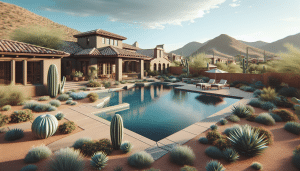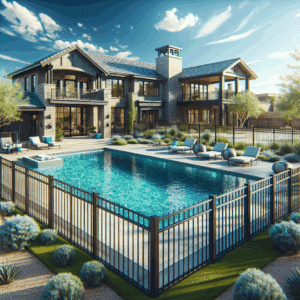
Living in Mesa means the pool is basically the center of the universe for about eight months out of the year, providing relief from that intense Valley sun. But for parents, that shimmering blue water is a double-edged sword—it’s the best fun imaginable, but it also keeps you up at night worrying about safety. Picking the right barrier isn’t just about ticking a box for the city inspector; it’s about finding a material that can stand up to our brutal summers while keeping your little ones secure.
Contents
- 1 Wait, Does the Material Really Matter That Much?
- 2 The Mesh Pool Fence: The Arizona Favorite
- 3 Glass Fencing: The Aesthetic Dream (and Maintenance Nightmare?)
- 4 Wrought Iron and Aluminum: The Classic Approach
- 5 Wood Fencing: Why You Should Probably Skip It
- 6 Comparing the Materials at a Glance
- 7 The Forgotten Hero: Gates and Latches
- 8 A Word on Installation (Don’t DIY This)
- 9 Making the Choice for Your Family
Wait, Does the Material Really Matter That Much?
You might be thinking, “A fence is a fence, right?” Well, not exactly. Especially not here in Arizona. You see, the material you choose dictates not only how the fence looks but how it performs when the thermometer hits 115 degrees. Some materials get so hot they can burn a child’s hand, while others might become brittle under the relentless UV rays we get day in and day out.
And honestly? There’s the visibility factor. You want a child-safe pool fence that physically stops a toddler, sure. But you also want to be able to see through it. If you’re grilling burgers on the patio and the kids are playing in the yard, a solid wall might block your view of the water, which is actually less safe than you’d think.
Let me break down the heavy hitters in the pool fencing world so you can figure out what makes sense for your backyard.
The Mesh Pool Fence: The Arizona Favorite
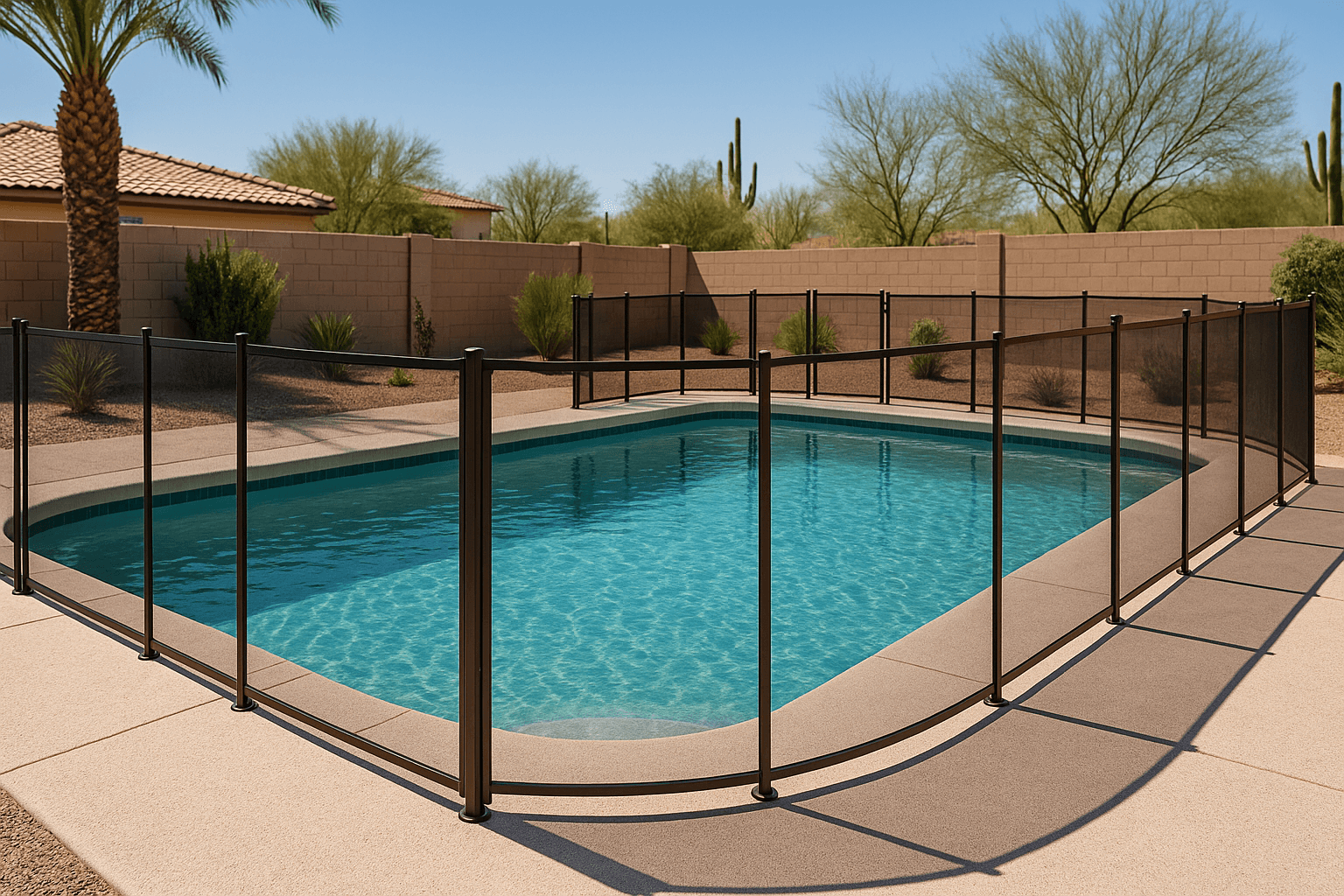
If you look around neighborhoods in Mesa, you’ll notice that removable mesh fencing is easily the most common choice. There is a reason for that. Actually, there are a few reasons.
Mesh fencing is built using a strong, transparent fabric stretched tight between aluminum poles. It’s what we call a “tension-based system.” The tighter it is, the safer it is.
Here’s why it works so well here:
- It’s Climb-Resistant: Unlike chain link or ornamental iron, mesh doesn’t have holes or horizontal bars that act as a ladder. Little feet can’t find a foothold. It is just a smooth wall of fabric.
- Visibility: You can see right through it. It has this weirdly magical quality where it’s strong enough to stop a child but transparent enough that you can keep an eye on the pool water from the kitchen window.
- Temperature Control: This is a big one for us in the desert. Mesh fabric does not absorb heat the way metal does. If your child leans against it in July, they aren’t going to get burned.
A Quick Note on “Removability”
The cool thing about mesh is that it is usually designed to be removable. Let’s say you’re hosting an adults-only cocktail party or the kids have grown up and moved out. You can take the fence down in minutes and store it away. However, most parents I know just leave it up year-round because, well, it’s easier.
But—and this is important—you have to make sure the mesh is UV resistant. Cheap mesh will rot in the Mesa sun within a couple of years. You want high-grade, textilene mesh that laughs in the face of UV radiation.
Glass Fencing: The Aesthetic Dream (and Maintenance Nightmare?)
Okay, let’s talk about glass. If you look at interior design magazines, frameless glass fencing is everywhere. It looks stunning. It’s like having an invisible shield around your pool. It preserves your view completely and adds a very modern, high-end feel to the backyard.
But here is the thing about glass in Mesa.
We have dust. Lots of it. And we have hard water. If you have glass shower doors, you know the struggle of keeping them clean. Now imagine that glass is outside, getting hit by sprinklers and monsoon dust storms.
Pros of Glass:
- Unbeatable Looks: It creates that resort vibe immediately.
- Climb Proof: It’s a slippery sheet of glass; there is zero way for a kid to scale it.
Cons to Consider:
- The Heat Trap: Glass panels can reduce airflow, creating a bit of a greenhouse effect on the pool deck.
- The Birds: Occasionally, birds don’t see it. That can be… unpleasant.
- Cleaning: Unless you enjoy squeegeeing your fence every Saturday morning, it’s going to show dirt and water spots instantly.
If you have a pool service or a landscaper who handles cleaning, glass is a fantastic child-safe pool fence option. If you are doing the maintenance yourself? Just make sure you’re ready for the upkeep.
Wrought Iron and Aluminum: The Classic Approach
For a long time, iron was the standard. It looks sturdy, it feels permanent, and it matches the architecture of many Southwestern homes.
There is a difference between wrought iron and aluminum, though they look similar. Iron is heavy and strong, but it rusts. In Arizona, we don’t have as much humidity as Florida, but our sprinkler systems and pool splashes will eventually cause iron to corrode if it isn’t powder-coated properly. Aluminum, on the other hand, is rust-resistant and lighter, making it a generally better pick for pool areas.
The Safety Catch:
You have to be careful about the spacing. The vertical bars—called pickets—must be close enough together (usually less than 4 inches) so a small child can’t squeeze through. Also, you have to ensure there are no decorative elements in the middle of the fence that could act as a step. Kids are surprisingly creative climbers. If there is a foothold, they will find it.
Also, keep in mind the heat factor. Dark metal in the Mesa sun gets scorching hot. Like, fry-an-egg hot. If the fence is close to the water where people are walking, that radiant heat is something to think about.
Wood Fencing: Why You Should Probably Skip It
I’ll be brief here. Wood fences are great for privacy around the perimeter of your yard, but they are generally a bad idea for the immediate pool barrier.
Why? Visibility.
A solid wood fence blocks your view completely. You can’t see if someone fell in. Plus, wood warps in our dry heat. It cracks, splinters, and requires staining every year or two. And let’s not even get started on termites. For a pool safety barrier, wood just introduces too many variables that can fail over time.
Comparing the Materials at a Glance
Sometimes it helps to just see it all laid out. Here is how these materials stack up specifically for our Mesa environment.
| Material | Heat Resistance | Maintenance Level | Child Visibility |
|---|---|---|---|
| Mesh Fence | High (Stays cool) | Low (Rinse occasionally) | Excellent |
| Glass | Low (Traps heat) | High (Cleaning spots) | Perfect |
| Aluminum | Medium (Gets hot) | Low (Rust-free) | Good (Depends on spacing) |
| Wrought Iron | Low (Gets very hot) | Medium (Watch for rust) | Good |
| Wood | Medium | High (Stain/seal) | Poor (Blocks view) |
The Forgotten Hero: Gates and Latches
You can have the strongest titanium fence in the world, but if the gate doesn’t work, the fence is useless.
This is where the mechanics matter more than the material. For a truly child-safe pool fence, the gate must be self-closing and self-latching.
What does that mean? It means if you walk through with a tray of lemonade and forget to close the gate behind you, it swings shut on its own and clicks into a locked position. You don’t have to turn around and check it.
The latch needs to be high up—out of the reach of wandering hands. We usually use magnetic latches (like the MagnaLatch) because they are reliable and don’t jam up with dust as easily as mechanical springs. When you hear that click, you know the barrier is secure.
A Word on Installation (Don’t DIY This)
I know, I know. We all love a good weekend project. But installing a tension-based mesh fence or drilling into concrete decking for glass panels isn’t the same as putting together a bookshelf.
The tension has to be precise. If a mesh fence is loose, a child can pull it down or squeeze under it. If the core drilling for the poles isn’t angled correctly, the fence will lean.
In Mesa, the ground can be incredibly hard (caliche, anyone?) or deceptively sandy depending on where your house sits. Professional installers know how to anchor these fences so they withstand the monsoons and the wear and tear of daily life. It’s worth the investment to know it was done right.
Making the Choice for Your Family
Here’s the thing: there is no single “perfect” fence for every single home. It depends on your budget, your backyard layout, and how much cleaning you want to do. But for most families in Mesa, the mesh fence offers that sweet spot of safety, affordability, and durability against the sun.
Your peace of mind is worth more than anything else. You want to be able to sit inside, enjoy the air conditioning, and look out at your backyard oasis knowing that the pool is secure.
If you are ready to secure your pool and want to discuss which material fits your specific backyard style and budget, give us a call at 480-771-8026. We’re here to help you make your home safer, so feel free to Request A Free Quote today and let’s get that barrier built.