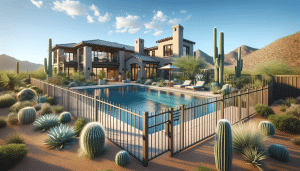

Living in Mesa implies that having a pool isn’t just a luxury; for about six months out of the year, it feels like a biological necessity to survive the heat. But with that sparkling blue backyard retreat comes a heavy dose of responsibility that goes way beyond skimming leaves or checking pH levels.
Contents
- 1 So, Why All the Fuss About Fences?
- 2 The Legal Landscape: Mesa vs. The State
- 3 What Actually Makes a Fence “Compliant”?
- 4 Mesh vs. Iron: The Great Material Debate
- 5 The “Layers of Protection” Philosophy
- 6 Common Violations We See (Don’t Do This!)
- 7 Maintenance: The Sun is the Enemy
- 8 Keeping It Beautiful and Safe
- 9 Let’s Secure Your Sanctuary
So, Why All the Fuss About Fences?
You know the feeling, right? You’re sitting inside, maybe enjoying the A/C, and suddenly your stomach drops because you can’t remember if you locked the back slider. Honestly, that anxiety is something every pool owner deals with. It’s not just about following rules or avoiding a stern letter from the city; it’s about protecting your loved ones.
In Arizona, drowning is unfortunately a leading cause of injury and death for young children. It’s a heavy topic, I know. But here’s the thing: most of these accidents are preventable. That’s where a proper pool safety barrier comes in. It’s not just a fence; it’s the silent sentry standing guard when you turn your back for five seconds to grab a fresh towel.
The Legal Landscape: Mesa vs. The State
Navigating the bureaucracy can feel like driving on the US 60 during rush hour—slow and frustrating. But let’s break it down simply. You have the Arizona Revised Statutes (specifically ARS 36-1681) and then you have Mesa’s specific city codes. Usually, the city code is what you really need to worry about because it tends to be more specific.
If you are buying a home with an existing pool or building a brand new one, the requirements can shift slightly, but the core goal remains the same. The city wants to ensure that a child under the age of six cannot easily access the water from the house or the yard without adult help.
For most residential pools in Mesa, a perimeter fence is non-negotiable. But it’s not just about slapping up some chain link and calling it a day. The specific dimensions and mechanics matter. If you have an older home, you might hear people talk about being “grandfathered in.” I’d be careful with that mindset. Grandfathered or not, water doesn’t care about when your house was built.
What Actually Makes a Fence “Compliant”?
Let’s get into the nitty-gritty. I won’t bore you with every single subsection of the code, but there are some non-negotiables that every Mesa homeowner needs to know. If you’re looking at your current setup and sweating a little, don’t worry—that’s what we are here to fix.
Here is a quick breakdown of the critical safety standards:
| Feature | The Requirement | Why It Matters |
|---|---|---|
| Minimum Height | Typically at least 5 feet (60 inches) high. | Prevents taller toddlers or adventurous kids from simply hoisting themselves over. |
| Gaps and Openings | No gaps larger than 4 inches; 2 inches if chain link. | Stops a child from squeezing through or getting a head stuck. |
| The Gate | Must be self-closing and self-latching. | Humans forget to close gates. Gravity and springs do not forget. |
| Latch Height | Must be at least 54 inches above the ground. | Keeps the release mechanism strictly out of reach for little hands. |
You see, the logic here is pretty sound. The self-closing gate is probably the most crucial part. How many times have you walked through a door with an armful of groceries (or pool noodles) and just assumed it clicked shut behind you?
Mesh vs. Iron: The Great Material Debate
When you look around Mesa neighborhoods, you’ll see a mix of wrought iron and removable mesh pool fencing. Which one is better? Well, that depends on what you value, but let me explain why mesh is taking over.
Iron fences are sturdy, sure. They have that classic look. But have you ever touched black iron in July when it’s 115 degrees outside? It’s a branding iron. Plus, wide bars can sometimes offer a foothold for climbing if they have ornamental scrollwork. Kids are surprisingly like little ninjas; if there is a toe-hold, they will find it.
Mesh fencing, on the other hand, is generally considered “climb-resistant.” There are no horizontal bars to step on. The weave is too tight to get fingers into. Plus—and this is a big one for aesthetics—it’s often semi-transparent. You can see through it to keep an eye on the water, which is a huge safety plus.
The “Layers of Protection” Philosophy
Okay, I’m going to go on a slight tangent here, but it’s relevant. A fence is your linebacker—it’s the main defense. But you shouldn’t rely on just one thing. Safety experts (and us folks at Pool Safety Fencing) always talk about “layers of protection.”
Think of it like Arizona sun protection. You don’t just wear a hat; you wear a hat, sunglasses, and sunscreen.
- High Door Locks: Even if you have a fence, install locks on your back doors that are way up high.
- Pool Alarms: There are devices that float in the water and scream if the surface is disturbed.
- Swimming Lessons: This is the layer that stays with the child. Mesa has great programs for this.
If the fence fails (or is left open), the door lock might save you. If the door is unlocked, the alarm might save you. See where I’m going with this? It’s about redundancy.
Common Violations We See (Don’t Do This!)
You’d be surprised what we see when we go out for inspections or quotes. Sometimes, homeowners try to DIY their safety barriers to save a buck, but it often ends up costing more in the long run to fix it.
One major issue is placing the fence too close to the water. You want enough deck space inside the fence to walk comfortably, but not so much that it becomes a play area. If you put the fence right on the edge of the coping, and someone falls, they’re hitting the fence or the water awkwardly.
Another big one? Propping the gate open. I get it. You’re having a BBQ, people are going in and out with burgers. You grab a rock or a brick to hold the gate. Then the party ends, you’re tired, you clean up… and the rock stays there. The next morning, the barrier is useless. It happens more often than you think.
Also, watch out for “climbable objects” near the fence. You might have a perfectly code-compliant 5-foot fence, but if you push a patio chair right up against the outside of it, you’ve just built a staircase for a toddler. Planters, pool equipment filters, and decorative rocks can all defeat the purpose of the fence if placed incorrectly.
Maintenance: The Sun is the Enemy
We live in the desert. The sun destroys everything eventually—your car dashboard, your patio furniture, and yes, your pool fence. UV rays are relentless.
If you have a mesh fence, check the tension every season. A loose fence is a floppy fence, and a floppy fence is easy to push down. If you have an iron fence, look for rust on the hinges. A rusty hinge might prevent that self-closing mechanism from doing its job.
You know what? Go check your gate right now. Seriously. Open it halfway and let it go. Does it click shut firmly? Now open it just two inches and let go. Does it still latch? If it bounces off or stops short, you need to adjust that spring tension immediately.
Keeping It Beautiful and Safe
Safety doesn’t have to mean your backyard looks like a prison yard. Modern pool safety fencing comes in various colors—brown, black, beige—to blend with your landscaping. The goal is for the fence to disappear into the background so you can enjoy the view of your pool without the constant heart-pounding worry.
It’s a balance, isn’t it? You want the fun, the splashes, the cannonballs. But you need that underlying assurance that when the fun is over, the danger is sealed off.
Let’s Secure Your Sanctuary
At the end of the day, you can read all the regulations in the world, but nothing beats having a professional eye take a look at your specific setup. Whether you need a brand new installation or just want to upgrade an old, questionable barrier, we are here to help you navigate the Mesa codes and keep your family secure.
Don’t wait until a close call wakes you up to the risks in your backyard. Give us a ring today at 480-771-8026 to discuss your options, or Request A Free Quote online so we can get started on giving you the peace of mind you deserve.