Living here in the Valley, a backyard pool isn’t just a luxury; it’s pretty much a survival tool against those triple-digit summers. But having that sparkling oasis comes with a massive responsibility that keeps plenty of us parents up at night. You want the fun, sure, but you also need the absolute certainty that your little ones—and maybe the neighbor’s curious dog—are safe when you aren’t watching.
Contents
- 1 Wait, isn’t a fence just a fence?
- 2 It’s all about the tension (and the surface)
- 3 The “Climb-Resistant” Factor
- 4 Figuring out the flow of your backyard
- 5 Will it survive a Mesa summer?
- 6 The Gate: The Weakest Link
- 7 Can I just do this myself on a Saturday?
- 8 Don’t set it and forget it
- 9 Making the Safe Choice
Wait, isn’t a fence just a fence?
You know what? I used to think that way too. Put up some barriers, lock a gate, and call it a day. But when you really get into the weeds of pool safety fencing, you realize there is a world of difference between a fence that looks safe and one that actually is safe.
Here’s the thing: kids are smarter (and faster) than we give them credit for. If there is a way to climb it, crawl under it, or wiggle through it, they will find it. Especially here in Mesa, where we spend so much time outdoors, the barrier becomes part of the daily landscape. It’s easy to get complacent.
Proper installation isn’t just about digging holes; it’s about understanding the physics of tension and the psychology of a toddler. Arizona pool barrier laws are strict for a reason, but meeting the code is just the baseline. We want to go beyond just passing an inspection; we want actual peace of mind.
It’s all about the tension (and the surface)
If you have ever leaned against a mesh fence and felt it give way like a hammock, that fence was installed wrong. A properly installed removable Mesh Pool Fence needs to rely on bi-directional tension. That’s a fancy way of saying the fence needs to be tight enough to stand rigid, but flexible enough to absorb impact without snapping.
Let me explain how we get that tension. It starts with the drilling.
We don’t just hammer a drill bit into your pool deck. That’s a recipe for cracked concrete and wobbly poles. We use a process called wet core drilling. Imagine a diamond-tipped bit that grinds a perfect, smooth circle into the concrete or pavers while water keeps everything cool. It creates a precise socket. Why does this matter? Because if the hole is even a fraction of an inch off, your fence poles won’t stand straight. If the poles aren’t straight, the mesh sags. And if the mesh sags, a child can pull it down.
The “Climb-Resistant” Factor
Honestly, this is where most DIY jobs fail. You might buy a kit online, follow the instructions, and end up with a fence that has what we call “footholds.”
A truly safe barrier must be climb-resistant. This means:
- No crossbars: Traditional iron fencing often has horizontal bars. To a three-year-old, that’s just a ladder.
- Mesh density: The weave of the mesh needs to be tight enough that little fingers and toes can’t get a grip.
- Height requirements: Standard safety height is usually 4 or 5 feet, tall enough to discourage an adventurous toddler from trying to hurdle it.
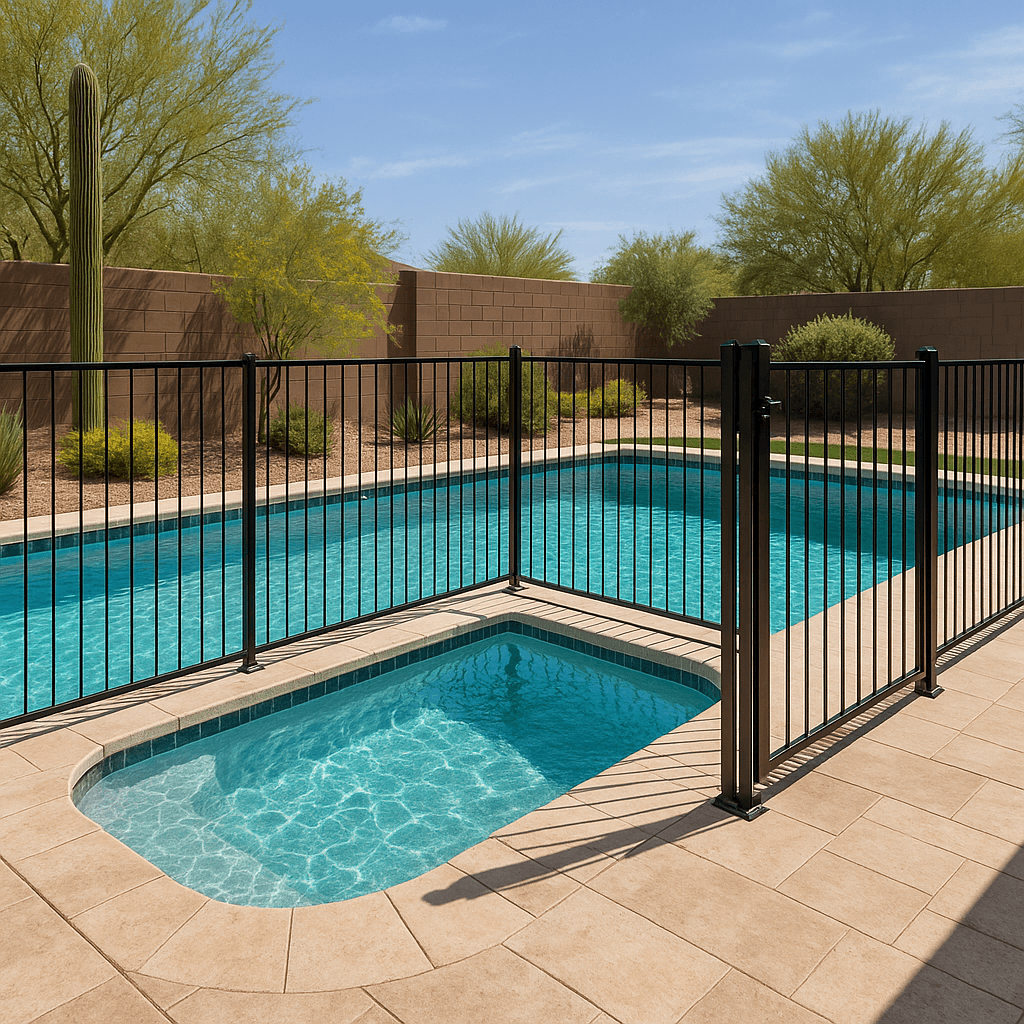
If you are looking at iron fencing, the spacing between the vertical bars is critical. It has to be less than 4 inches. Why 4 inches? It’s the average size of a small child’s head. If the head fits, the body follows. It’s a scary thought, but thinking about these scenarios is how we prevent them.
Figuring out the flow of your backyard
You don’t want your backyard to feel like a prison yard. I get it. We pay a lot for our views of the Superstitions or just our own landscaping.
When planning an installation, the layout is just as important as the materials. You have to consider the “traffic pattern” of your patio.
- The Gate Placement: The gate should be located near the shallow end or steps, usually where you naturally walk towards the pool.
- Line of Sight: Can you see the pool clearly from the kitchen window or the sliding glass door? Your pool barrier shouldn’t block your view of the water. This is why transparent mesh or glass is so popular.
Sometimes, people try to cut corners and use the house as the “fourth wall” of the fence. While legal in some specific setups with door alarms, it’s risky. Door alarms fail. Batteries die. Teenagers disable them. The safest route is always an isolation fence—one that goes all the way around the water.
Will it survive a Mesa summer?
Let’s be real for a second. The sun here in Mesa is brutal. It eats plastic for breakfast and fades paint by lunch. When you are choosing materials, you have to think about UV resistance.
A cheap fence from a big-box store might look great in May, but by September, it could be brittle and chalky. Once the material becomes brittle, its safety rating drops to zero.
Here is a quick look at how different materials hold up in our desert climate:
| Material Type | Heat Retention | Maintenance Needs | Safety Note |
|---|---|---|---|
| Mesh Fencing | Low (Safe to touch) | Minimal (Rinse with hose) | No footholds; very hard to climb. |
| Wrought Iron | High (Can burn skin) | Moderate (Painting/Rust) | Watch for rust spots weakening the base. |
| Glass | Medium | High (Cleaning spots) | Can act like a magnifying glass for heat; birds hit it. |
Mesh pool fencing is usually the winner here because it doesn’t get scorching hot. If a child falls against it in July, they won’t get burned. Plus, the high-quality poles we use are reinforced to withstand those random monsoon microbursts that knock over your patio chairs.
The Gate: The Weakest Link
You can have the strongest fence in the world, but if the gate doesn’t latch, you have nothing.
The industry standard—and frankly, the only thing you should trust—is a self-closing, self-latching gate. It uses magnetic latches, often known by the brand Magna-Latch. These are brilliant pieces of engineering. When the gate swings shut, a magnet pulls the latch bolt into place. It doesn’t rely on a spring that might wear out or get stuck.
Also, the latch needs to be high up. We install them on the inside of the fence, near the top, so a child would have to be fairly tall and possess decent dexterity to reach over and pull it.
But here is a tip even for those with pro installs: Check your gate every month. The ground shifts. The heat expands metal. Sometimes the alignment gets thrown off just a hair. A quick check to ensure it clicks shut every time is a habit that saves lives.
Can I just do this myself on a Saturday?
I love a good DIY project. I built my own planter boxes last spring. But when it comes to life safety devices? That is a different ballgame.
The margin for error with pool fence installation is tiny. We are talking millimeters. If you hit a piece of rebar while drilling your deck and try to force it, you crack the deck. If your angle is off by two degrees, the fence leans, and the gate won’t self-close.
Plus, professionals have tools that simply aren’t in the average homeowner’s garage. We use core drills that cost more than a used Honda. We have jigs and levels designed specifically for pool terrain, which is almost never perfectly flat.
And let’s not forget the slope. Most pool decks slope away from the water for drainage. Installing a straight fence on a sloping surface requires custom adjustments to the poles and mesh borders. If you don’t get that right, you end up with gaps at the bottom where a pet or small child could squeeze under.
Don’t set it and forget it
Once the fence is up, it feels like you can finally relax. And you can! But you also need to keep an eye on things.
We recommend walking the perimeter of your pool safety fence before the swim season kicks off. Look for:
- Loose tension: Does the mesh feel saggy?
- Gate alignment: Does it click shut on the first swing?
- Sleeve integrity: Are the plastic sleeves in the ground cracked?
Living in Mesa, dust is just a fact of life. Hose the mesh down occasionally. Dirt can actually work its way into the fibers and degrade them over time if it sits there for years. A simple spray keeps it looking fresh and extends the life of the material.
Making the Safe Choice
At the end of it all, a pool is meant to be a place of joy. It’s where you cool off after a long week, host barbecues, and teach your kids to swim. You shouldn’t have to look at that water with a knot in your stomach.
Proper installation techniques—like precise core drilling, calculating the correct tension, and ensuring latch reliability—transform a physical barrier into emotional security. It allows you to enjoy your backyard without that constant, nagging “what if” playing in the back of your mind.
If you are looking at your pool right now and wondering if it’s as safe as it could be, don’t guess. We are right here in the neighborhood and happy to help you assess your setup. You can reach out to us by phone # 480-771-8026 to chat about your options, or Request A Free Quote online to get the ball rolling on a safer backyard today.