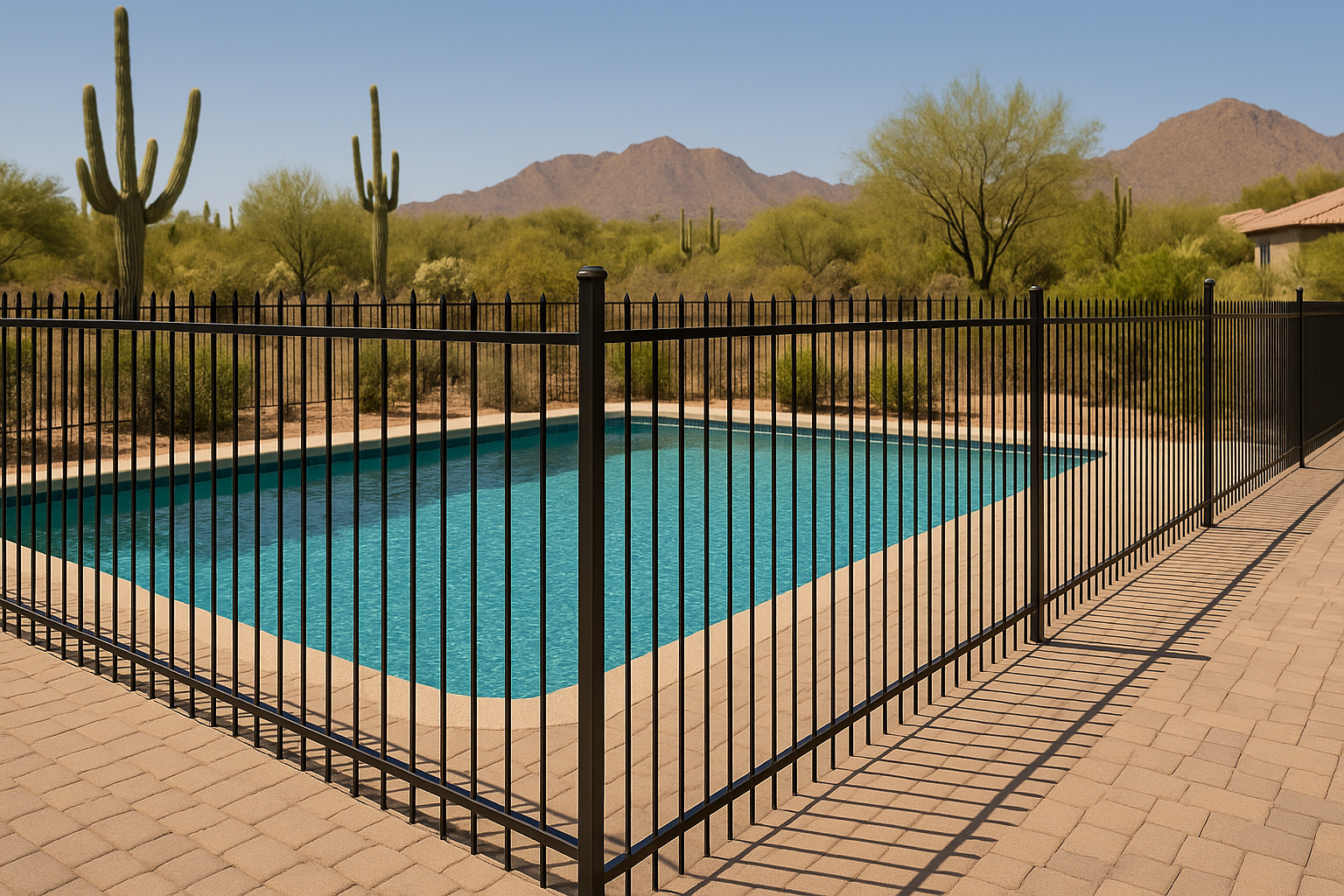
Living in Mesa means navigating triple-digit summers where a backyard pool isn’t just a luxury; it’s pretty much a survival tool. But with the joy of splashing around comes a heavy dose of responsibility, specifically making sure that sparkling water stays safe for kids and pets. You might be eyeing wrought iron fencing for its classic look and durability against our relentless sun, but before you start digging post holes, you need to understand the local safety codes that dictate exactly how that fence needs to be built.
Contents
Why Wrought Iron is the Mesa Favorite
Let’s be honest for a second. When you look around neighborhoods in the Valley, you see a lot of block walls and a lot of wrought iron. There is a reason for that. Wood fences just don’t stand a chance out here. Between the intense UV rays baking the moisture out of the timber and the occasional termite invasion, wood is a maintenance nightmare.
Wrought iron, on the other hand, is tough. It allows for airflow—which is nice when that evening breeze finally kicks in—and it lets you keep an eye on the pool area from the patio. You want that visibility. It’s not just about aesthetics; it’s about knowing instantly if someone is near the water who shouldn’t be. Plus, it adds a certain elegance that mesh fences sometimes lack. It feels permanent. It feels secure.
But here is the catch. Because wrought iron consists of bars and rails, it has the potential to become a ladder if it isn’t designed correctly. And that is exactly what the Mesa pool code is trying to prevent.
The “Non-Climbable” Zone
You know what toddlers are like. They are relentless explorers with zero sense of danger. If there is a way to climb over something, they will find it. This is why the geometry of your fence matters so much.
The regulations focus heavily on spacing. If your fence has horizontal bars—which it needs for structure—they can’t be too close together. If the distance between the top horizontal rail and the bottom horizontal rail is less than 45 inches, a child can use them like steps on a ladder.
To pass inspection and, more importantly, to keep your family safe, you usually have two options:
- Space the horizontal rails at least 45 inches apart.
- Put the horizontal rails on the pool side of the fence, so the outside face is flush and smooth, leaving no toe-holds for a climbing kid.
Also, we have to talk about the vertical bars. The gap between them generally cannot exceed 4 inches. Why 4 inches? It’s the standard diameter of a small child’s head. The rule exists to prevent a child from getting their head stuck between the bars, which can be just as dangerous as falling into the water.
Height Matters: The 5-Foot Rule
When we talk about pool barriers, height is your first line of defense. In Mesa, and generally across Arizona statutes, the standard requirement for a pool enclosure is a minimum height of 60 inches (5 feet) measured from the ground on the side facing away from the pool.
Now, you might see some older fences that are shorter. Grandfather clauses can be a tricky subject, and honestly, relying on them is a gamble with safety. If you are installing new fencing or doing a major remodel, you have to hit that 60-inch mark.
Here is a detail people often miss: the ground clearance. You can’t have a big gap at the bottom. The space between the bottom of the fence and the ground shouldn’t exceed 2 inches when measured on the outside. You don’t want a curious toddler—or a determined puppy—squeezing underneath.
The Gate: The Most Important Moving Part
You can build a fortress of a fence, but if the gate fails, the whole system fails. It’s the weak link. How many times have you walked through a gate with an armful of towels or a cooler and just kicked it shut behind you?
The regulations account for human error. Your wrought iron pool gate must meet three non-negotiable criteria:
- Self-Closing: It must swing shut and latch on its own from any open position.
- Self-Latching: It needs to lock automatically without you turning a key or sliding a bolt.
- Outward Opening: The gate must open away from the pool area.
Why outward? Imagine a child pushing against the gate to try and get in. If it opens inward, their weight might push it open if the latch fails. If it opens outward, their pushing actually forces it closed against the latch. It’s a simple physics trick that saves lives.
The latch mechanism itself needs to be placed high up—usually at least 54 inches above the ground—so it’s out of reach for little hands. If it’s lower, it needs to be on the pool side, protected by a shield so no one can reach through the bars to open it.
Decorative Hazards
We all like things to look nice. In Mesa, you see a lot of Southwestern style—scrollwork, decorative knuckles on the pickets, maybe some fancy finials on top.
Here is the thing, though. Decorative ironwork can be a code violation if you aren’t careful. Those pretty scrolls? To a safety inspector, those look like footholds. Anything that creates a horizontal surface or a protrusion large enough for a tiny foot to step on is a “climbable object.”
When you are picking out your design, you have to balance style with strict geometry. You can still have a beautiful fence, but the decorative elements usually need to be near the very top of the fence, well above the reach of a climbing child, or designed in a way that doesn’t offer purchase for a foot.
Rust, Heat, and Maintenance
This isn’t a regulation per se, but it effects whether your fence stays legal. Mesa is dry, but we have monsoon season. We have irrigation sprinklers. Iron creates rust.
If your fence rusts through, or if the hinges get stiff from oxidation, your self-closing gate stops self-closing. Suddenly, you are code non-compliant and, more worryingly, unsafe.
Powder coating is the industry standard here. It’s a baked-on finish that is much tougher than standard paint. However, even the best coating can chip. You need to keep an eye on the bottom of the posts where weed whackers tend to chip the paint, and on the hinges. A little bit of maintenance goes a long way.
How Wrought Iron Stacks Up
It helps to see how wrought iron compares to other common barrier types we see in Arizona backyards.
| Feature | Wrought Iron | Removable Mesh | Glass Panels |
|---|---|---|---|
| Durability | Extremely High (Decades) | Medium (Sun damage over time) | High (But fragile to impact) |
| Airflow | Excellent | Poor (Blocks breeze) | None (Blocks breeze) |
| Climbability | Low (If built to code) | Non-Existent | Non-Existent |
| Maintenance | Paint/Touch-ups needed | Tension checks needed | Frequent cleaning (Water spots) |
| Aesthetics | Classic / Permanent | Functional / Temporary look | Modern / High-end |
The “Door Alarms” Confusion
Sometimes, homeowners think, “I don’t need a fence between the house and the pool; I’ll just use door alarms.”
Technically, Arizona law and Mesa codes do allow for a perimeter fence around the whole yard combined with alarms on all doors leading to the pool. But let me tell you, reliance on electronics is risky. Batteries die. Teenagers disable them because they’re annoying. You leave the sliding door open to grill burgers.
A dedicated isolation fence (a fence that separates the pool from the house and the rest of the yard) is the gold standard for safety. It adds that layer of protection for when the back door is accidentally left ajar. Most safety experts—and parents who have had a close call—will tell you that physical barriers beat electronic ones every day of the week.
Getting It Right the First Time
Navigating city codes can feel like learning a new language. The terminology—”maximum vertical clearance,” “horizontal separation,” “latching mechanism strictures”—is dry and boring. But the intent behind it is emotional and urgent.
You are trying to create a backyard oasis where you can relax, not a place where you have to be on high alert every second. A properly installed wrought iron fence gives you that peace of mind. It looks good, it lasts forever, and it keeps the most vulnerable members of your family safe.
If you are unsure about the current state of your pool barrier, or if you are planning a new installation, don’t guess. The stakes are too high. You need a partner who knows the Mesa codes inside and out and can weld a fence that is both beautiful and fortress-secure.
We can help you navigate these regulations and build a barrier that enhances your home’s value while prioritizing safety. For a consultation or to ask about specific code questions, give us a ring at 480-771-8026 or simply Request A Free Quote online to get started.